TETA Research Chair displays world-class research achievements and skills development
Academics
29 December 2025
By Phumla Mkize
Two innovations in the pipeline. A total of 10 Honours graduates produced. World-class research in electrical and civil engineering by four Master’s and three Doctoral students.
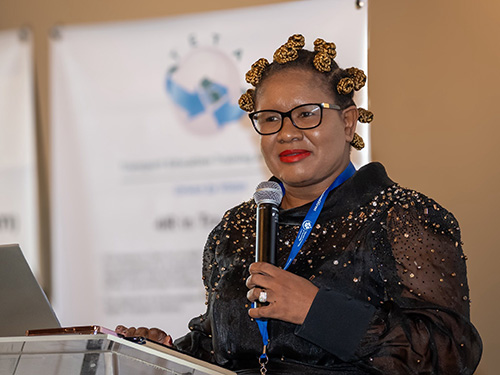 Deputy Vice-Chancellor for Research, Innovation and Engagement Dr Vathiswa Papu-Zamxaka commends the Chair for its cross-border collaboration.
Six articles published in accredited, high-impact journals. Two short-learning programmes (SLPs) in digital skills and artificial intelligence (AI) developed, benefitting 80 learners and unemployed youth. Two training programmes on digital transformation for small, medium and micro enterprises (SMMEs) completed. These are remarkable feats by a Research Chair in less than four years.
Deputy Vice-Chancellor for Research, Innovation and Engagement Dr Vathiswa Papu-Zamxaka commends the Chair for its cross-border collaboration.
Six articles published in accredited, high-impact journals. Two short-learning programmes (SLPs) in digital skills and artificial intelligence (AI) developed, benefitting 80 learners and unemployed youth. Two training programmes on digital transformation for small, medium and micro enterprises (SMMEs) completed. These are remarkable feats by a Research Chair in less than four years.
The achievements were shared by the Tshwane University of Technology (TUT) during a research seminar and stakeholder feedback event, which brought together its partner the Transport Education Training Authority (TETA), collaborators and stakeholders to showcase the work of the TETA Research Chair for an Agile Transportation Industry.
The seminar featured presentations by TUT researchers and academics, partners and collaborators from the University of Gustave Eiffel (UGE), the French South African Institute of Technology (F’SATI) and the TUT AI Hub of the AI Institute of South Africa. Master’s and Doctoral students supported by the Chair and the Postdoctoral Fellow under the Chair presented their research.
The main aim of the TETA Research Chair, established in 2022, is to assist in developing and embedding digital transformation tools and skills to help with road infrastructure management. The Chair does this by focusing on four components – research and innovation; capacity development of postgraduate students; skills development of secondary school and unemployed youth; and small, medium and micro enterprise (SMME) training.
Road quality measurement
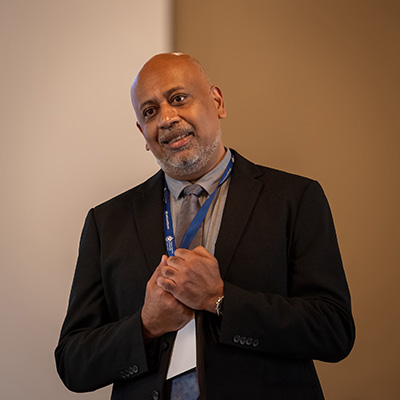 Chairholder Prof Anish Kurien highlights the excellent work done by the Chair.
The Chair – led by Prof Anish Kurien and supported by Prof Lamine Dieng from UGE and various TUT staff and students – has developed a low-cost digital diagnostic device for road quality measurement to assist in road infrastructure management in collaboration with UGE and French industry partner, LogiRoad. The initiative was also supported by the French Embassy in South Africa, Lesotho and Malawi. The University is also working on a multimodal fatigue detection tool to monitor driver fatigue, one of the major causes of accidents on South Africa’s roads.
Chairholder Prof Anish Kurien highlights the excellent work done by the Chair.
The Chair – led by Prof Anish Kurien and supported by Prof Lamine Dieng from UGE and various TUT staff and students – has developed a low-cost digital diagnostic device for road quality measurement to assist in road infrastructure management in collaboration with UGE and French industry partner, LogiRoad. The initiative was also supported by the French Embassy in South Africa, Lesotho and Malawi. The University is also working on a multimodal fatigue detection tool to monitor driver fatigue, one of the major causes of accidents on South Africa’s roads.
Prof Kurien explained that one of the questions that guided the work of the Chair was “How to overcome the burden that is associated with monitoring roads in South Africa?”
“Currently road monitoring is done manually. You will see cars on national roads manually checking and collecting information,” said Prof Kurien, “It is an inefficient way of collecting information.” The question of how this process could be digitalised with visual representation of the road quality was asked during the development of the objectives of the Chair.
Phone app to the rescue
He shared that the team’s first strategy was to use a tool called Miranda, sourced through TUT partner UGE.
“Miranda is an app that runs on any Android-based smartphone. Today’s smartphones are powerful devices and contain the necessary sensors to collect information such as an accelerometer, geolocation capabilities as well as data connectivity. Data can be collected easily. The objective of using the app was to easily collect data and classify the quality of the road,” said Prof Kurien.
Based on the outcomes of the first research project that aimed at classifying the quality of national, provincial and regional roads, the next focus was to integrate AI-based technologies to complement the sensory data collected using computer vision techniques
“There is nothing better than visual inspections, but one of the objectives was to take the human out of the visual inspections by automating it to alleviate the potential for human error as well as to reduce the human burden [of collecting information],” added Prof Kurien.
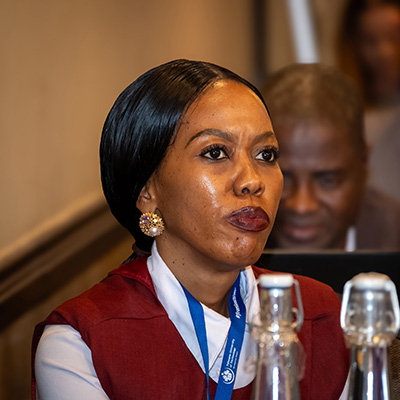
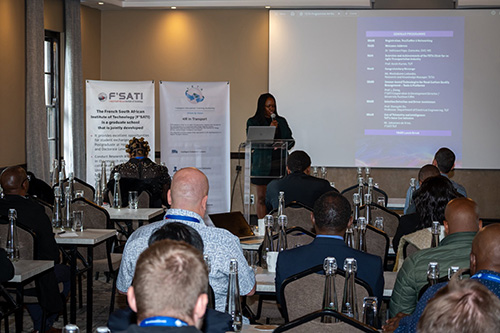 Mashabane Ledwaba, Research and Knowledge Manager at TETA, delivers her message of congratulations.
Measurement vehicle for road information sensing
Mashabane Ledwaba, Research and Knowledge Manager at TETA, delivers her message of congratulations.
Measurement vehicle for road information sensing
The research conducted in the project has led to TUT developing a special-purpose, measurement vehicle for road-sensing. The vehicle is fitted with equipment sourced with assistance from the French Embassy, UGE and LogiRoad. The various sensors fitted in the vehicle incorporate accelerometers, GPS and Lidar sensors that enable road data to be collected autonomously as one drives. The information is currently collected and stored on an onboard computer box. A forward-facing camera is also installed to collect video and images from the front of the vehicle.
TUT’s low-cost technology
The research team further developed a low-cost variant of the UniBox platform that makes it a more viable solution for the South African and Africa context. The developed platform, called RoadSense, enables the same type of sensory data to be collected.
“The tool has been tested on campus and on roads outside campus. Both tools provide information on road quality. The main benefit of the platforms is their ability to autonomously collect information and store it automatically once a drive is completed” elaborated Prof Kurien.
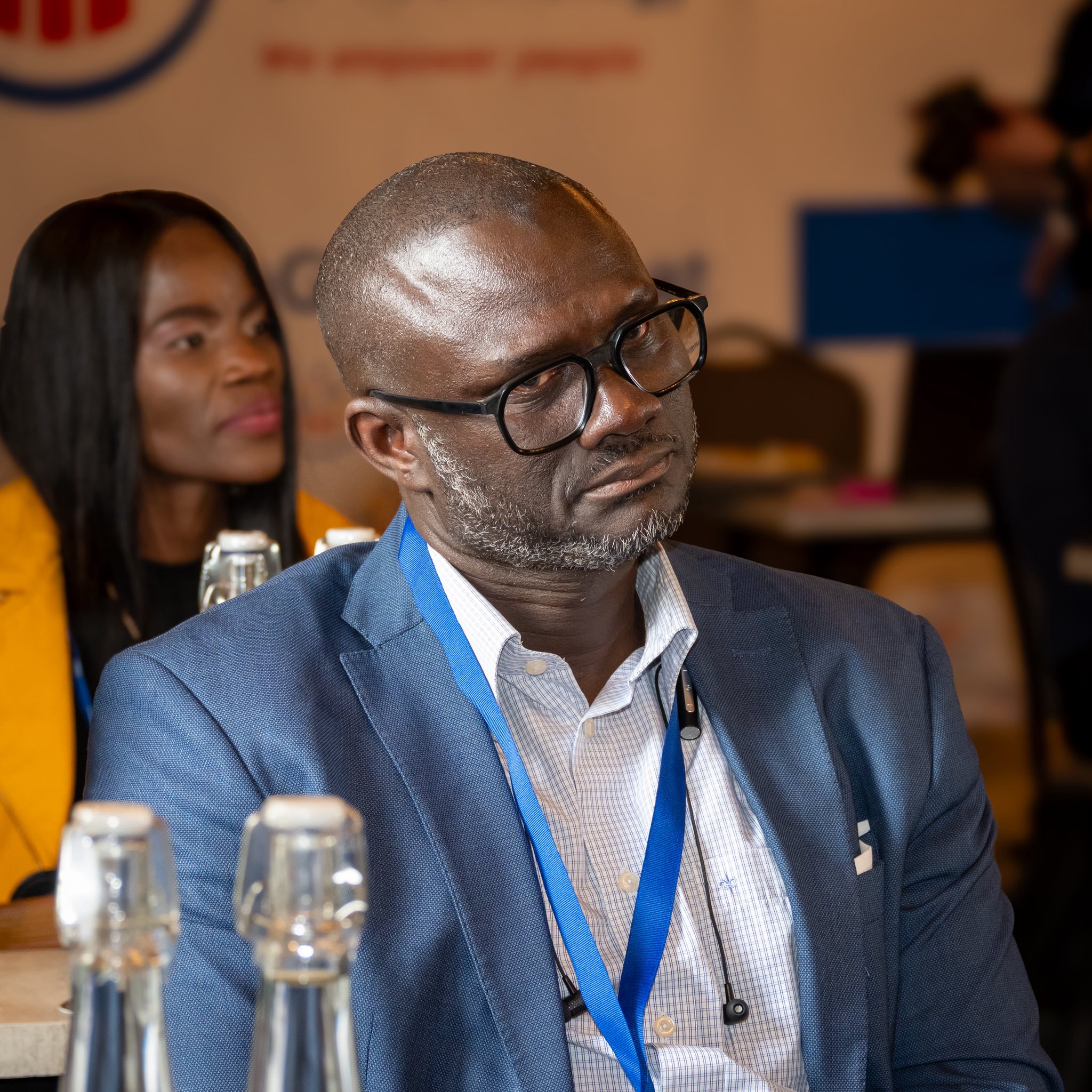 Partner and supporter Prof Lamine Dieng from the University of Gustave Eiffel in France
Multi-modal solution for driver fatigue
Partner and supporter Prof Lamine Dieng from the University of Gustave Eiffel in France
Multi-modal solution for driver fatigue
To assist with one of the challenges in the public transport system, TUT is currently developing a solution for driver fatigue analysis using multi-modal data. “A lot of solutions use a visual-based approach. TUT uses a multimodal approach using various sources such as heart rate together with video so that you can pick when a person is in distress,” explained Prof Kurien.
The work of the Chairs contributed to six articles in Department of Higher Education and Training-accredited, high-impact journals.
Postgraduate student support
A total of 10 Bachelor of Engineering Technology Honours students were supported through the Chair, two of whom have continued to register for their Master’s in Electrical Engineering. The Chair also supports three Doctoral students and one Postdoctoral Fellow.
Skills development and SMME training
Through the Chair, two SLPs were conducted; one benefitted 80 learners, including providing them with a general understanding of AI, while the other targeted unemployed youth by focusing on rapid prototyping to empower them with skills to be self-employed in areas such as cellphone repairs. In addition, two training workshops were held for SMMEs on digital transformation skills.
 One of the Doctoral candidates supported by the Chair Neo Motsilanyane
Deputy Vice-Chancellor for Research, Innovation and Engagement Dr Vathiswa Papu-Zamxaka underscored the role of innovation and resilient infrastructure for inclusive and sustainable development. She emphasised the importance of partnerships and collaboration for impactful research, commending the TETA Research Chair for its multidisciplinary nature and cross-border collaboration.
One of the Doctoral candidates supported by the Chair Neo Motsilanyane
Deputy Vice-Chancellor for Research, Innovation and Engagement Dr Vathiswa Papu-Zamxaka underscored the role of innovation and resilient infrastructure for inclusive and sustainable development. She emphasised the importance of partnerships and collaboration for impactful research, commending the TETA Research Chair for its multidisciplinary nature and cross-border collaboration.
“Digital transformation is not only about technology; it is about people, partnerships, and purpose. Together, we can build a transport sector that is safer, smarter, more efficient and globally competitive,” she said.