International residency elevates TUT fine artists’ practice
AcademicsInternationalisation
19 February 2026
By Gerrit Bester
Two Master’s students in Art and Design put TUT on the international map during a prestigious Wheaton Arts & Cultural Centre residency in Millville, New Jersey, USA, late last year.
At the Faculty of Arts and Design Spotlight on Postgraduate Studies, Research & Innovation on 16 February 2026, Inga Lokwe and Francois Pietersen showcased the power of collaboration, the faculty’s theme for the year, by sharing the vibrant cultural exchange they experienced and the skills they refined during the residency.
The residency provided Lokwe and Pietersen with 24-hour access to world-class studio facilities, specialist technical resources, housing close to the studio and a stipend. Additional financial support was given by the Department of Fine and Studio Arts to cover their travel costs.
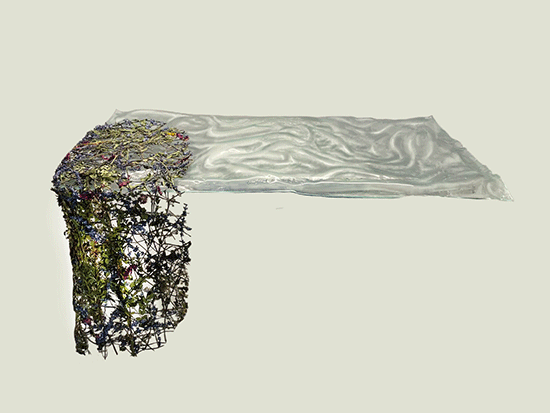 Woven in Silence, co-created during the residency, carries deeply personal meaning for both artists.
WOVEN IN SILENCE
Woven in Silence, co-created during the residency, carries deeply personal meaning for both artists.
WOVEN IN SILENCE
The highlight was a discussion of Woven in Silence, a one-by-one-metre work co-created during the residency. It carries deeply personal meaning for both artists and depicts a blanket (in glass) and doily (a small ornamental mat, typically made of lace, crochet or fine fabric) of pressed flowers.
In this work, centred around grief, Lokwe and Pietersen aim to transcend the cultural limitations of South Africa, creating a human narrative that speaks to a broader, universal audience. “At the heart of our journeys is grief – a complex and transformative emotion that forces us to confront our deepest selves. Through grief, we redefine our understanding of loss, resilience and the ways in which we heal,” they say.
Their journeys through grief are shaped by the distinct cultural contexts they come from.
Lokwe’s experience of grief is closely tied to the loss of her mother, a journey framed by the traditions of Xhosa culture. In times of sorrow, the "grief blanket" is customarily given to offer comfort, wrapped around the grieving to provide a space for healing. However, Lokwe’s path diverged from these expectations as she navigated her understanding of womanhood, embracing a new perspective that did not align with traditional roles.
For Pietersen, grief takes the form of isolation and the pressure of growing up in a traditional Afrikaans household, where maintaining a specific image of masculinity is paramount. The weight of this expectation often led to feelings of estrangement and grief for the parts of himself he was not allowed to express.
In addition, Pietersen mourns the forced disconnection from his own culture. This seclusion, driven by the cultural refusal to accept his identity, has led him to grieve not only his personal experiences but also the loss of his culture – a culture that, by rejecting him, feels increasingly distant and inaccessible.
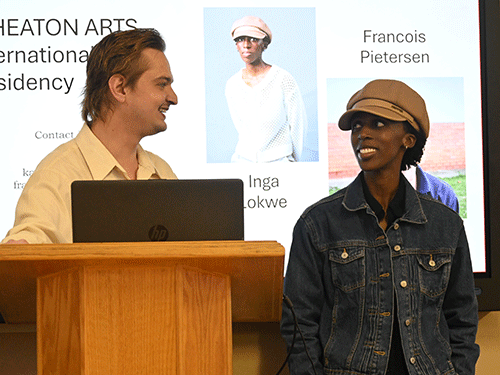 Francois Pietersen and Inga Lokwe speaking about the residency they completed at the Wheaton Arts & Cultural Centre in Millville, New Jersey, USA, late last year.
TWO EXPERIENCES MERGED INTO ONE
Francois Pietersen and Inga Lokwe speaking about the residency they completed at the Wheaton Arts & Cultural Centre in Millville, New Jersey, USA, late last year.
TWO EXPERIENCES MERGED INTO ONE
Bringing together the Xhosa grief blanket and the Afrikaans doily in the work is a symbolic merging of two unique experiences. These objects, each rooted in their respective cultures, represent their journeys toward healing. The blanket, traditionally offering warmth and solace, and the doily, both protective and fragile, come together to create a narrative of comfort, understanding and mutual support. In contrast, the doily, commonly found in Afrikaans households, is a decorative yet protective element, often used to safeguard everyday objects. While its presence is widespread globally, it has become a stereotypical facet of Afrikaans culture.
Pietersen’s use of a doily, pressed with flowers, represents a fragile form of protection. The delicacy of the doily, prone to breaking, reflects how cultural systems falter when individuals deviate from their norms.
Ultimately, this body of work is about more than just grief. It speaks to the strength found in vulnerability, the connection formed through shared experiences and the power of creating a safe space where healing can begin.
“Through our collaboration, we found not only solace but also a deep bond with one another. We hope that through this work, others too may find the comfort and strength to embrace their own journeys of loss, growth and transformation,” they say.
ART RESHAPES THE ARTIST
Lokwe eloquently notes that while art is often perceived as created for an audience, the act of making can, and does, reshape the artist themselves.
The piece has since been taken up by the Museum of American Glass, marking a notable milestone as the first African artists to receive this recognition.
The presentation also discussed how the residency context influenced their conceptual and material decisions and how international audiences engaged with the work. It highlighted the role of international residencies in expanding artistic research, fostering cross-cultural understanding and placing South African art practices within broader global conversations.
In response to questions about what they carried forward from the residency, Lokwe and Pietersen say the experience broadened their perspectives beyond personal environments. They noted that the residency connected them with audiences who value their work and helped them develop a new, enduring skill set that they can rely on throughout their artistic careers.
Lokwe’s practice draws on her experiences as a Black lesbian woman, foregrounding African womanism and queerness while interrogating narrow definitions of what constitutes African identity. Through her work, she creates space for the rural, the queer and the often unseen.
Pietersen, meanwhile, probes the complexities of growing up gay within a traditional Afrikaans household, challenging toxic masculinity and reimagining manhood in contemporary South Africa. He frequently returns to childhood symbols, using flowers (heat prints, pressed specimens and living blooms) as his primary medium to express identity and to contest conventional associations of florals with femininity and notions of “kitsch” in the art world.
- The Wheaton Arts & Cultural Centre, founded in 1968 as Wheaton Village, is a non-profit organisation dedicated to engaging artists and audiences through creative programming. The centre features gallery spaces, performance areas, classrooms and administrative offices, supporting visual arts, education and cultural events. It receives funding from organisations like the New Jersey State Council on the Arts and continues to serve as a hub for artistic expression and community engagement.
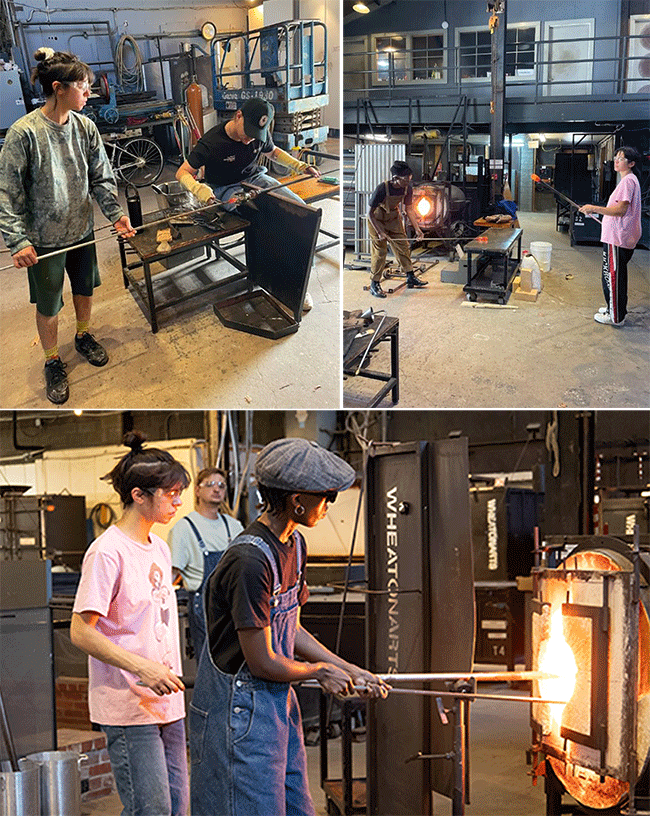 Lokwe and Pietersen with Anna Yiaxi Savvidou, a fellow from Cyprus.