Students take first steps on their creative journeys
Academics
10 February 2026
By Gerrit Bester
Nestled on 24 Du Toit Street, the Tshwane University of Technology’s Arts Campus now buzzes with the energy of 516 first-year students.
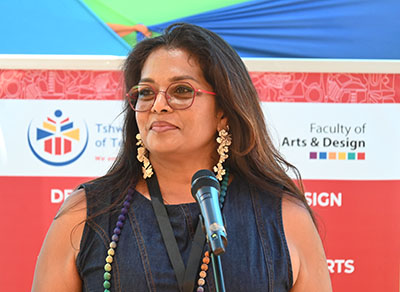 Prof Nalini Moodley, Executive Dean of the Faculty of Arts and Design, during the official welcome of first-year students to the faculty.
This year’s cohort was selected from a pool of over 10 000 applicants and is pursuing studies across Fine and Studio Arts, Interior Design, Performing Arts, Visual Communication and Fashion Design.
Prof Nalini Moodley, Executive Dean of the Faculty of Arts and Design, during the official welcome of first-year students to the faculty.
This year’s cohort was selected from a pool of over 10 000 applicants and is pursuing studies across Fine and Studio Arts, Interior Design, Performing Arts, Visual Communication and Fashion Design.
On 6 February at noon, the students were officially welcomed to the Faculty of Arts and Design during a memorable welcome event. Prof Nalini Moodley, Executive Dean, framed the day with a gentle challenge: freedom, she said, is a gift with its own responsibilities.
FREEDOM COMES WITH RESPONSIBILITY
“As you begin this new phase of life, it is important to understand that university brings freedom, but like all freedoms, this comes with responsibility. There are a few expectations,” Prof Moodley said.
“First, regular class attendance and participation matter. Being present is not optional if you want to succeed, particularly in these creative and practice-based disciplines.
Second, respect is essential. Respect for yourself, your body, one another, staff and the campus spaces we share. A respectful environment supports creativity, safety and wellbeing.
Third, deadlines are part of professional life. The creative industries work to briefs, schedules and delivery dates. Learning to manage your time now prepares you for real-world practice.
Fourth, this faculty has a zero-tolerance approach to any form of violence, especially Gender-Based Violence. Each of us has a responsibility to create and protect a safe space for all,” she emphasised.
She added that starting university can feel overwhelming, but it is also a time full of possibilities. “The Tshwane University of Technology prides itself on being a university that empowers people and we are moving decisively towards becoming an entrepreneurial university.”
TOWARDS EMPLOYABLE GRADUATES
“It means that we have a dream, much like Martin Luther King had a dream. While his dream was for a just and equal society, ours is for an employable graduate who is skilled, confident, ethical and able to operate competently in industry while contributing to this country's economic growth. Our dream is that you leave here not only with creative talent, but with the business skills, values and mindset required to succeed in the creative industries.”
Prof Moodley continued to say that the first-years are joining the faculty during a time of global instability and that, in moments like these, artists carry a responsibility. “Artists are the conscience of society. They see what others cannot see and feel what others refuse to feel. Artists build empathy, global understanding and encourage cross-cultural dialogue.”
EMBRACE ARTIVISM
“As first-year students, you are entering the faculty at a moment when we are advancing a strong artivism agenda. We believe deeply that the arts have a legitimate and necessary role to play in responding to social challenges. Therefore, artivism is that space where art and activism intersect. We know full well that policies and frameworks alone are not addressing the national crisis of Gender-Based Violence, nor the urgent threat of climate change. As creatives, you must learn to see the world and its problems differently. We need your ideas, your voices and your courage.”
ART IS FUNDAMENTAL TO HUMAN DEVELOPMENT
Before she sent the first-years off on their new journeys, Prof Moodley underscored that an arts education, anywhere in the world, is not only about learning how to draw, design, perform, or make things. “It is about developing critical thinking, adaptability, empathy and problem-solving skills. These are the skills required in a rapidly changing world, especially one in which many future careers do not yet exist. Research shows that an arts education is as fundamental to human development and future success as literacy and mathematics.”
However, she also said that success does not come without failure.
 “Failure is not something to fear. You will receive criticism. You will doubt yourself. You will think you have failed. But every unsuccessful attempt teaches you something valuable. Growth in the arts depends on reflection, feedback and the courage to try again.”
Therefore, she encouraged students to make full use of the dedicated leadership and academic team, who were all present at the event alongside support staff from various environments. These staff members explained the services they offer to students on their academic journeys.
“As you begin your studies, be curious. Work hard. Believe that your ideas matter. This is a creative space that invites you to challenge yourselves and to grow. The world needs artists, designers, performers and thinkers who can imagine new possibilities and act on them. As part of an entrepreneurial university, your ideas, projects and collaborations can become businesses, social enterprises, cultural platforms and community initiatives,” Prof Moodley concluded.

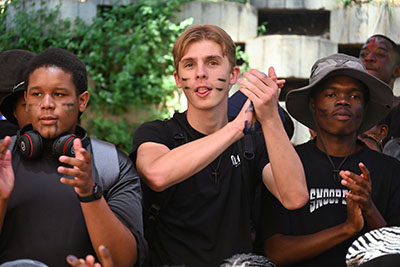
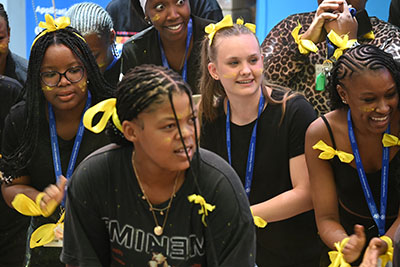
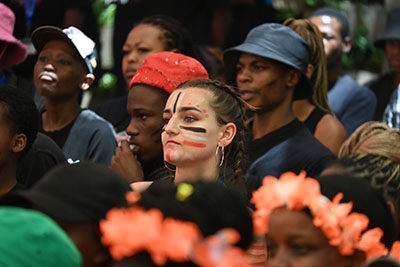
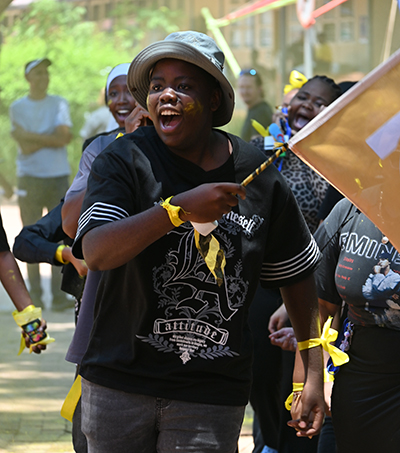

The Arts Campus now buzzes with the energy of 516 first-year students, selected from over 10 000 applicants.
📷 Gerrit Bester